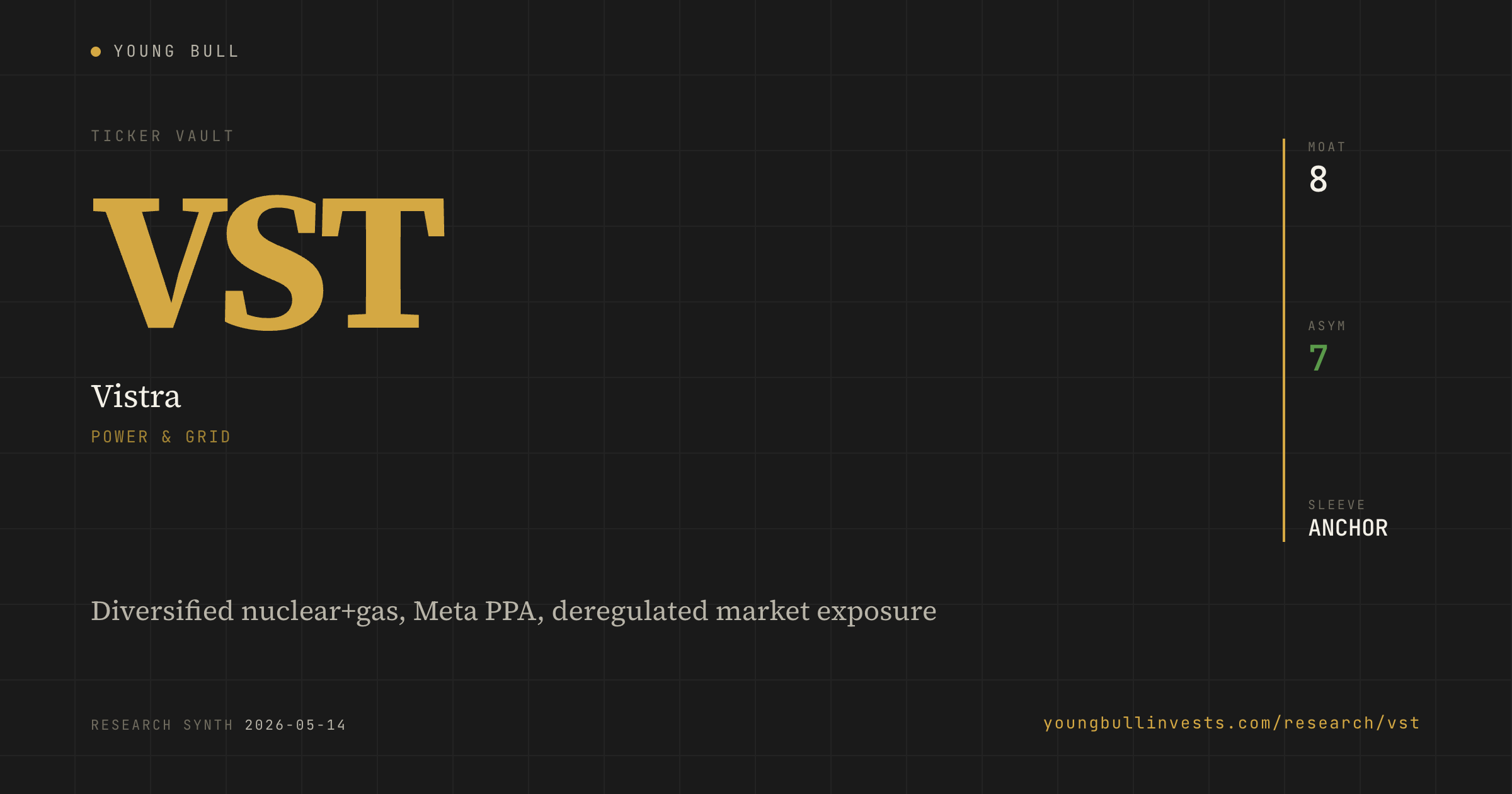
VST research
Position in the Physical Layer of AI thesis
VST is the power-and-grid anchor. The Physical Layer thesis breaks the moment a hyperscaler can plug a new datacenter into the grid faster than today's 5-7 year interconnect queue. Vistra runs the largest US nuclear fleet outside Constellation, plus a gas peaker portfolio, with deregulated market exposure that lets it sell power on behind-the-meter contracts. Microsoft signed a 20-year PPA with VST in late 2024. Meta signed in 2025. Both at premium pricing.
Quinn's book opened VST on 2026-04-06. The 2026-05-11 canonical snapshot has VST at -4.63 percent, the only red position among the 5 anchors. That is intentional: discipline rules say you size into a thesis position before the catalyst, not after. The catalyst here is the regulatory ruling on behind-the-meter contracts that determines whether the Microsoft and Meta PPAs hold structure as written.
Recent catalysts (last 30 to 60 days)
- NRC behind-the-meter ruling pending. The Federal Energy Regulatory Commission (FERC) and the Nuclear Regulatory Commission (NRC) are jointly reviewing the Talen / AWS Susquehanna deal, with the ruling expected late Q2 2026. A favorable ruling clears the path for similar VST + Microsoft + Meta structures. An adverse ruling forces renegotiation.
- ERCOT capacity factor revised up. 10-Q disclosed the Texas fleet operating at 0.93 capacity factor, the highest level on record. Power prices in ERCOT cleared above 2024 levels through most of Q1 2026, padding the gas peaker margins.
- Comanche Peak relicensing. Texas nuclear unit started the relicensing process for the 2030-2050 window. License extensions are valued at multiples of the asset book.
- Q1 print mixed. Net income beat. Revenue light. Guidance held. The miss is on the gas side (warm Q1), the beat is on contract sign-ups (Meta + smaller hyperscalers).
The thesis (what has to be true)
1. Hyperscaler power demand stays ahead of grid capacity through 2030. The interconnect queue does not unclog, so behind-the-meter PPAs are the only way to bring capacity online fast. 2. The NRC + FERC review lands favorably for behind-the-meter nuclear PPAs (or carves out enough structure that VST's contracts hold). 3. ERCOT and PJM stay structurally short of dispatchable power. Renewables alone are not enough, and battery storage doesn't fill the gap by 2027. 4. Microsoft and Meta do not renegotiate the PPAs lower on a thesis pivot.
Kill vectors (what would break the thesis)
- NRC rules against behind-the-meter contracts. This is the load-bearing regulatory question. An adverse ruling forces a structural redo on the Microsoft and Meta deals, with the new pricing likely 20-30 percent worse.
- Texas weather shock. A mild summer cuts ERCOT capacity factor below 0.85, which compresses gas peaker margins and brings the overall fleet earnings down.
- Constellation poaches a contract. CEG has the larger nuclear fleet and more political weight in Washington. If Microsoft moves its next major PPA to CEG instead of VST, the anchor thesis weakens.
- Mechanical exit at break. Discipline rule fires on close below $135 for two consecutive sessions. Currently at ~$147, so there is ~8 percent buffer between the live price and the kill price.
Layer context
In the 8-layer Physical Layer of AI map, VST is the Power & Grid anchor. Layer concentration is currently ~10 percent of book (well under the 30 percent cap). Sister names: BE (Bloom Energy, solid oxide fuel cells), SMR (NuScale, small modular reactors), CEG (Constellation, the other large nuclear fleet, not currently held).
VST is the cleanest mainstream way to express the power-bottleneck thesis. BE is earlier-stage and lumpy. SMR is single-product and pre-revenue at scale. CEG is the closest peer and may be the better risk-adjusted bet if VST breaks, which is why the anchor is named and the kill is documented.
Position discipline (the rules at entry)
- Trim trigger: +100 percent from cost. Lower threshold than the +200% standard because Power is a more cyclical anchor; lock the gain earlier.
- Kill vector exit: break of $135 for 2 consecutive days.
- 4-quarter thesis-fail rule applies. If the NRC ruling is adverse and the contracts get repriced down, the 4-quarter clock starts on the date of the ruling.
Moat 8. Asym 7. The asym is lower than NBIS or AVGO because Power & Grid has structural ceilings (regulated pricing, weather cyclicality), but the moat is high because nuclear fleet replacement cost runs in the tens of billions and is functionally unbuildable on a new-build basis in the US today.
Real money. Real position. Real receipts.