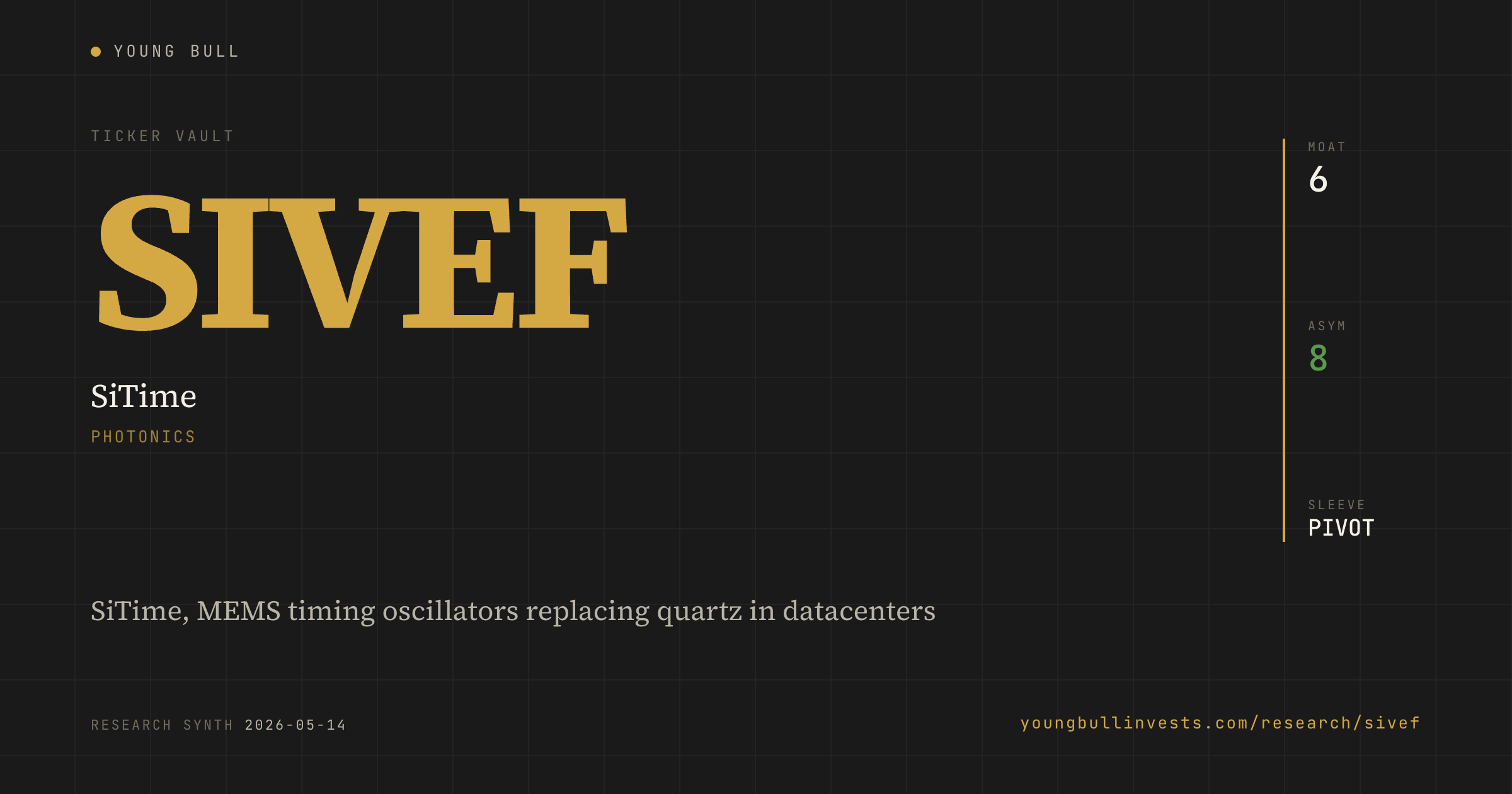
SIVEF research
Position in the Physical Layer of AI thesis
SIVEF is a Photonics pivot. SiTime makes MEMS-based precision timing oscillators that are replacing the legacy quartz-crystal timing components used in datacenter networking, 5G base stations, and high-frequency trading systems. The Physical Layer thesis hooks here: 800G+ optical interconnects require sub-picosecond timing accuracy, which quartz cannot reliably deliver at temperature extremes. SiTime is the dominant MEMS timing supplier.
Quinn's book opened SIVEF on 2026-04-21. The 2026-05-05 snapshot had SIVEF at +69.63%. Sized at 2.2% of book. Among the top winners by percent return.
Recent catalysts (last 30 to 60 days)
- Q1 2026 design wins disclosed. Three named hyperscaler datacenter networking customers for the precision-timing product line. Disclosed in the Q1 print as "tier-1 cloud networking customers."
- 5G O-RAN qualification. SiTime's chips qualified for the new O-RAN base station reference designs in late Q1. Opens a parallel revenue lane outside datacenter.
- Automotive ADAS qualification. First automotive-grade qualification at a major OEM. Long-horizon revenue but real.
- Capacity expansion announcement. Management disclosed plans for a second fabrication partner to add capacity through 2027.
The thesis (what has to be true)
1. MEMS timing oscillators continue to replace quartz at high-precision applications. The temperature stability + reliability advantage compounds at 800G+ and beyond. 2. SiTime stays the dominant supplier. Competitors (Microchip's MEMS timing portfolio, Murata) exist but at smaller scale. 3. The datacenter networking design wins convert to volume. Q1's "tier-1 cloud" customers need to show up in Q3-Q4 revenue. 4. The automotive + 5G adjacencies don't pull execution focus from the load-bearing datacenter business.
Kill vectors (what would break the thesis)
- Quartz catches up. Crystal vendors are improving temperature stability; if quartz becomes "good enough" for 800G+ at lower cost, MEMS share compresses.
- Hyperscaler in-house timing. Microsoft and Google have semi divisions that could in-house timing for their largest deployments.
- Foundry capacity miss. SiTime depends on a small set of MEMS foundries. A capacity allocation conflict (Apple, etc.) could squeeze.
- Single-customer concentration. Today's revenue is concentrated on a handful of cloud customers; a pivot is meaningful.
Layer context
Photonics layer per current metadata (Photonics is the closest fit since the products are precision-timing FOR optical systems; arguably could be classified as "Networking" too). Sister names: LITE (datacenter optical components, larger), ALMU (InP PICs, anchor), AXTI (compound semi substrates).
Position discipline
- Pivot sleeve rules.
- Trim trigger: +100 percent from cost. Position is already at ~$5.86 close (5/5), close to the trim level.
- 4-quarter thesis-fail rule applies. If the design wins don't convert to volume within 2 quarters, the clock starts.
Moat 6. Asym 8. The moat is moderate (MEMS timing is patented but reproducible). The asym is high because the position is small-cap with a concrete near-term revenue ramp from the disclosed design wins.
Real money. Real position. Real receipts.