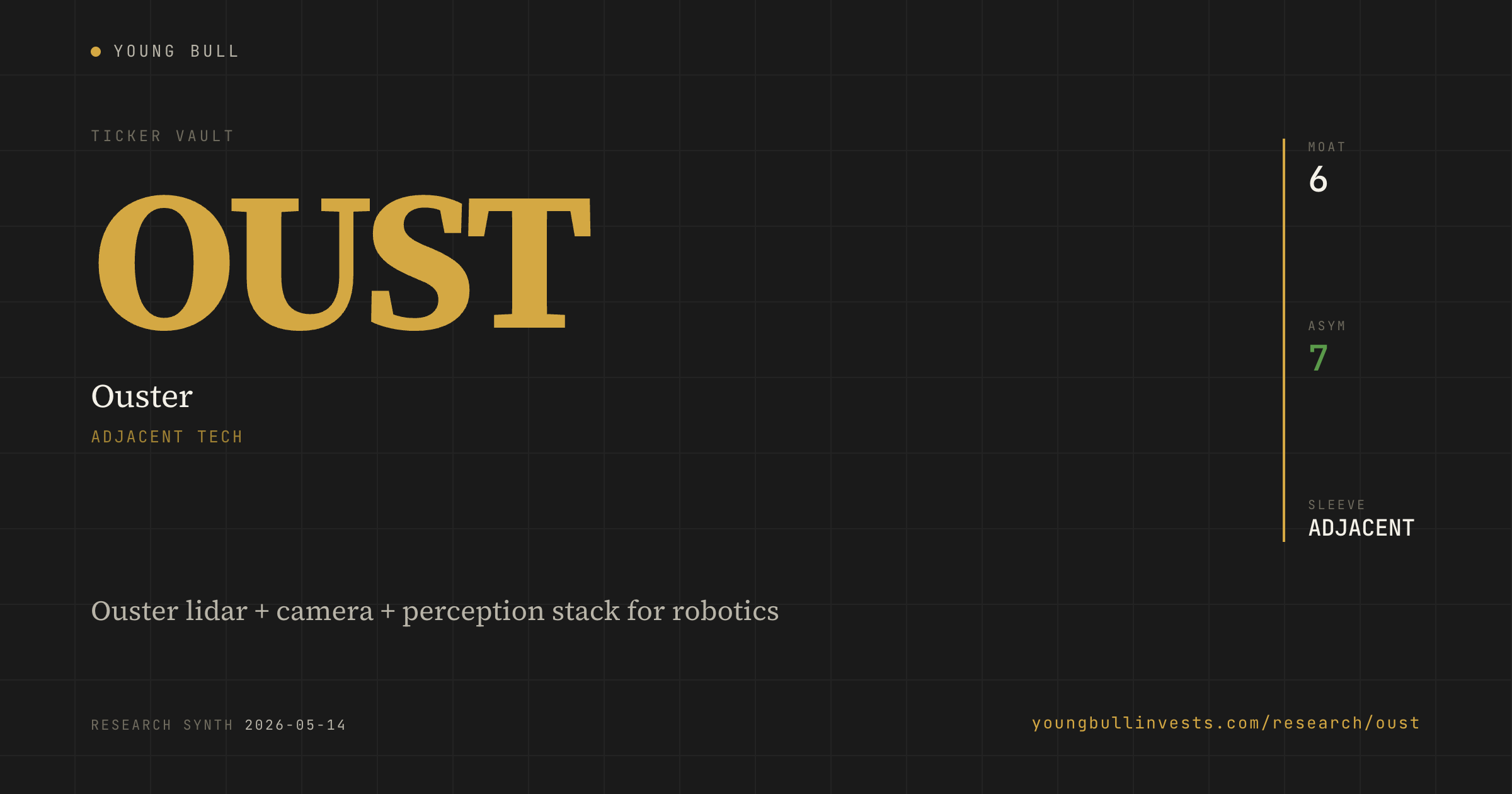
OUST research
Position in the Physical Layer of AI thesis
OUST is the third Adjacent Tech sleeve position. Adjacent Tech is the 4th sleeve added in manifesto v2 (2026-05-05) for technology bets that don't pass the Physical Layer signature line test but are concrete, real-revenue companies. Ouster builds digital lidar sensors plus the perception software stack that consumes them. The customer base is robotics + autonomous vehicles + smart infrastructure, not AI training compute. OUST is in the book because the AI thesis extends past datacenter into physical-world sensing.
Quinn's book opened OUST on 2026-04-28. The 2026-05-05 snapshot had OUST at +9.81%. Sized at 2.7% of book.
Recent catalysts (last 30 to 60 days)
- Velodyne integration (legacy) complete. The Ouster + Velodyne merger (closed 2023) has now fully integrated. Combined customer base is wider than either alone.
- Q1 2026 revenue growth +35 percent YoY. Driven by smart infrastructure + industrial automation customers.
- Robotics customer wins. Disclosed in Q1 the addition of three new humanoid-robotics customers (names not public) as lidar suppliers.
- Software revenue mix expansion. Perception software (Gemini stack) is now ~12 percent of revenue vs <5 percent a year prior. Higher-margin growth lane.
The thesis (what has to be true)
1. Lidar stays the dominant 3D-sensing modality for robotics + autonomous vehicles. The alternative is camera-only (Tesla-style); the rest of the industry uses lidar. 2. OUST's digital-lidar design wins over MEMS-based competitors (Innoviz, Luminar) at the cost-per-unit metric. 3. The robotics market accelerates. Humanoid + industrial robotics is the asymmetric upside. 4. Smart infrastructure (traffic, security) keeps growing as a recurring-revenue base.
Kill vectors (what would break the thesis)
- Camera-only wins. If Tesla's vision-only stack proves out at scale and the industry follows, lidar TAM compresses meaningfully.
- Chinese competition. Hesai Technology is the major Chinese lidar competitor with US listing. Pricing pressure is real.
- Robotics market deceleration. If humanoid robotics stays a 2027+ story and industrial automation grows slowly, OUST's pivot to robotics customers softens.
- Capital event. OUST has raised at compressed multiples historically; a dilutive secondary is the discipline break.
Layer context
Adjacent Tech sleeve (not Physical Layer). Sister names: ASTS (direct-to-cell satellite, highest asym), RKLB (launch + space systems, highest revenue quality). OUST is the lowest-variance of the three Adjacent Tech positions. The customer base is more diversified, the revenue is more recurring, the asym is correspondingly bounded.
Position discipline
- Adjacent Tech sleeve rules apply, not Anchor rules.
- No fixed +200% trim level; trim decisions are catalyst-driven (customer milestones, software-revenue mix targets).
- Sleeve cap: 15% of book. ASTS + RKLB + OUST = ~12% total in Adjacent Tech, under the cap.
- 4-quarter thesis-fail rule applies.
Moat 6. Asym 7. The moat is moderate (digital lidar is patented but reproducible; the cost-per-unit advantage compounds with scale). The asym is moderate-high because the robotics market is real and OUST is reasonably positioned.
Real money. Real position. Real receipts.