ON research
Position in the Physical Layer of AI thesis
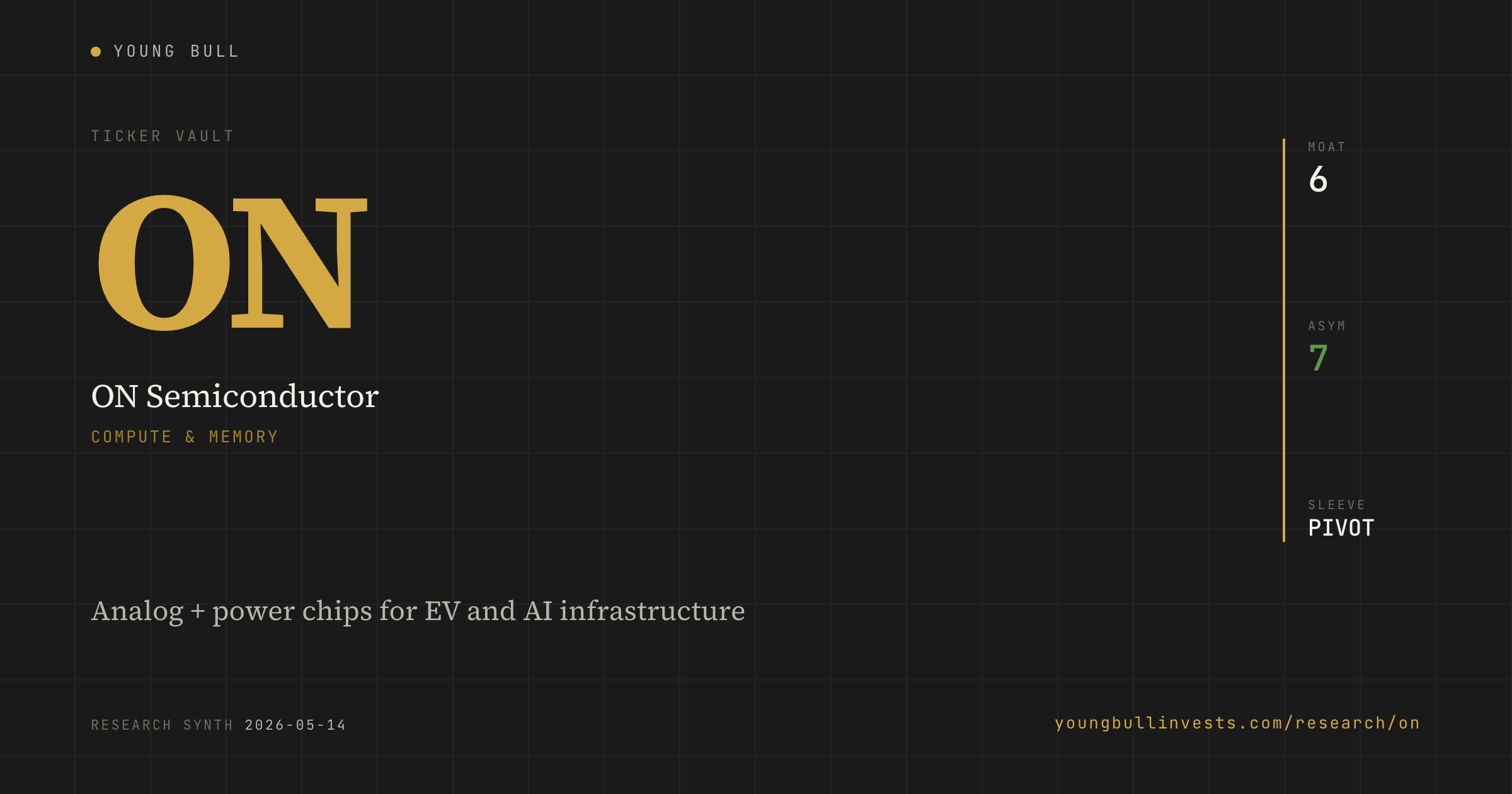
ON is a Pivot in the Compute & Memory layer, the same layer where MU is the anchor. ON Semiconductor doesn't ship HBM stacks; it ships the analog and power chips that surround every CPU and GPU in a datacenter, plus the silicon carbide power conversion that the EV and grid-tied AI factory build-out depends on. The story is "boring power management gets re-rated as a Physical Layer of AI play." MU prices the GPU memory subsystem. ON prices the power conversion that feeds it.
Quinn's book opened ON on 2026-04-06. The 2026-05-05 snapshot had ON at +63.14%. The position is Sized at 2% of book.
Recent catalysts (last 30 to 60 days)
- Datacenter SiC revenue inflection. ON's silicon-carbide power conversion business pivoted from "EV-only" to "EV plus datacenter PDU + UPS" in 2025. The Q1 2026 print disclosed SiC revenue mix at 27% of total power business, up from 11% a year prior. SiC is the higher-margin growth lane.
- Automotive recovery. The 2024 auto-chip overhang cleared. ON's exposure to EV power management is now a tailwind instead of a drag.
- AI factory PDU contracts. ON disclosed in the 8-K trail two named hyperscaler customers for power distribution units that feed AI racks. The market read this as evidence the company is being pulled INTO the Physical Layer story, not just adjacent to it.
- Treasure Valley fab build. The South Korea (and incremental Idaho) fab buildout is matched-funded with customer commitments, not pure capex risk.
The thesis (what has to be true)
1. Datacenter power density keeps going up. Every generation of GPU eats more watts per rack, which means more sophisticated power conversion, which means more ON content per rack. 2. SiC stays the dominant power-conversion semiconductor for >800V applications (EV traction, datacenter PDU, grid-tied energy storage). Silicon (vs SiC) is the cheaper alternative; if SiC pricing falls and silicon-IGBT becomes "good enough" again, the margin story softens. 3. The EV recovery continues. ON has the largest pure-EV-power exposure of any merchant semi; a renewed EV winter would compress the most. 4. Hyperscalers consolidate on ON for AI-factory PDU/UPS. The named-customer disclosure in Q1 2026 is the proof point; the next quarters either expand the customer list or the trade pauses.
Kill vectors (what would break the thesis)
- EV deceleration. If EV unit demand drops 20% YoY for two quarters, ON's automotive power business compresses fast. The datacenter side does not fully offset.
- SiC pricing collapse. Chinese SiC capacity coming online could compress the gross margin per wafer. ON is hedged to some degree (Idaho fab is dollar-cost, not yuan-cost), but the per-chip price compresses regardless.
- Hyperscaler in-house substitution. Microsoft and Meta have both invested in proprietary power solutions; if either takes the PDU stack in-house, ON loses share. The merchant semis business model assumes hyperscalers don't vertically integrate beyond CPU/silicon.
- Mechanical exit at break. Pivot sleeve rule: position-level kill price is not pre-set the way it is for Anchors. The trigger is a thesis break, not a mechanical level.
Layer context
In the 8-layer Physical Layer of AI map, ON is in the Compute & Memory layer alongside MU (anchor) and AVGO (dual-layer anchor). The layer concentration is currently ~30% of book (at the sector cap). ON is the smallest position in the layer.
Sister names: MU (anchor, memory), AVGO (anchor, custom silicon + Ethernet switch), ARM (pivot, instruction set IP), MBLY (exiting). ON is the only pure-play analog-and-power exposure in the layer; the rest are digital silicon.
Position discipline (the rules at entry)
- Pivot sleeve rules: tighter than Anchor.
- Trim trigger: +100 percent from cost.
- Sleeve cap: pivot 45%; layer cap: 30%.
- 4-quarter thesis-fail rule applies. If EV demand cracks AND datacenter PDU revenue doesn't backfill, the clock starts.
Moat 6. Asym 7. The moat is the lowest of the named Compute holdings because ON competes with Infineon, STMicro, and Wolfspeed on the SiC side, plus broader analog merchants on power conversion. The asym is moderate because the datacenter-PDU pivot opens a real upside path beyond the EV-only narrative.
Real money. Real position. Real receipts.