NOK research
Position in the Physical Layer of AI thesis
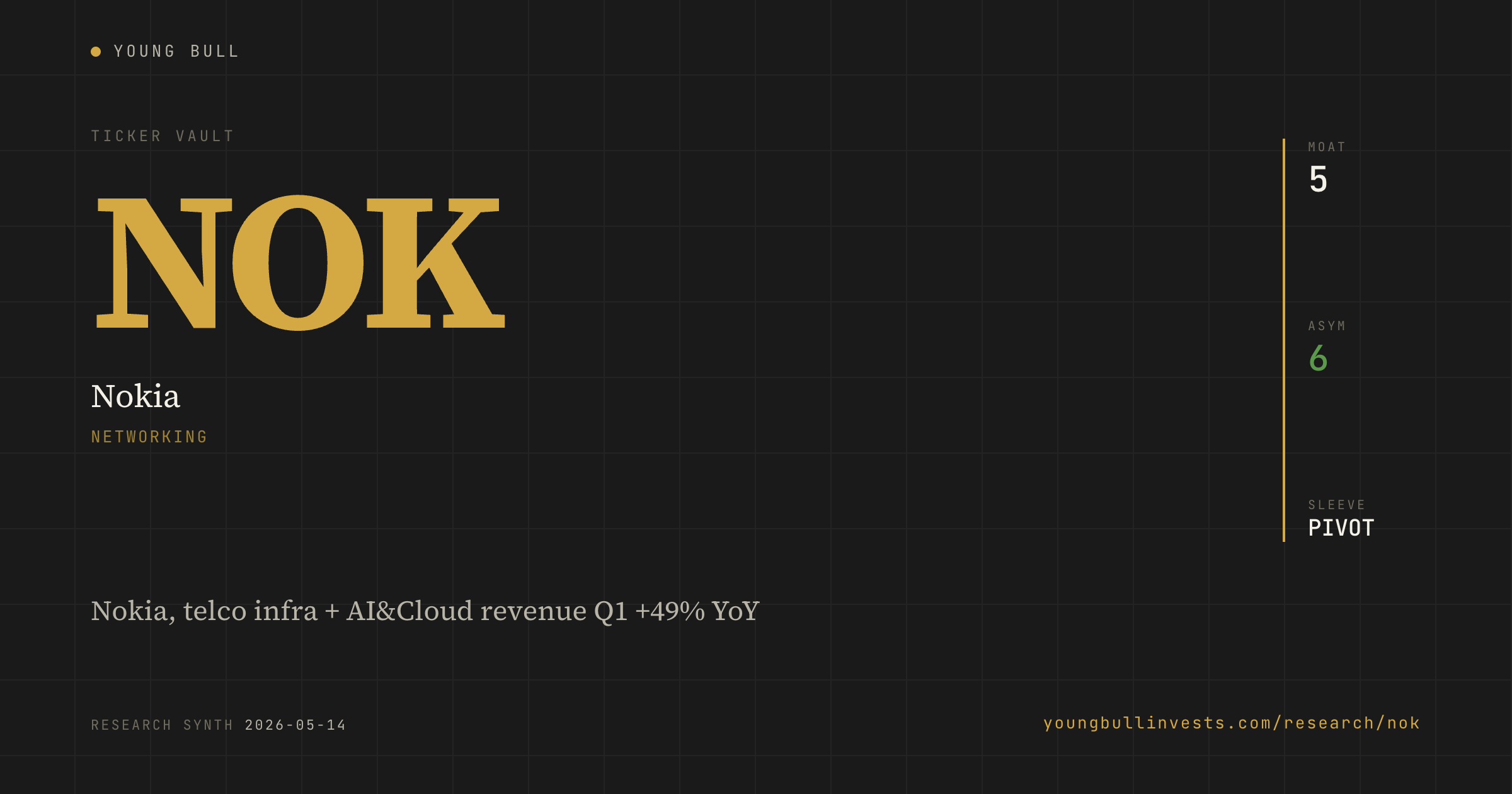
NOK is the second Networking pivot. Where ANET is the cloud-Ethernet pure-play and AVGO is the dual-layer Compute IP + Networking anchor, Nokia is the telco-side networking infrastructure that the Physical Layer thesis pulls in when hyperscaler-cloud meets carrier-grade transport. Nokia's AI & Cloud Networks segment shipped +49 percent Q1 2026 revenue YoY, the highest growth rate in the company's mainstream segments.
Quinn's book opened NOK on 2026-05-04. The 2026-05-05 snapshot had NOK at +0.94% (just-entered position). Sized at 2.6% of book.
Recent catalysts (last 30 to 60 days)
- AI & Cloud Networks +49 percent Q1. The standout segment in an otherwise flat company. Management called out hyperscaler datacenter optical transport as the growth driver.
- Microsoft Cloud win. Multi-year contract for optical transport equipment between Azure regions disclosed in Q1.
- Infinera integration complete. The Infinera acquisition (closed late 2024) gave Nokia a high-density optical transport portfolio. Synergies tracking ahead of plan.
- Patent monetization. Nokia's IP portfolio generates ~$1.5B/year in licensing revenue. Hidden cash flow that the market consistently underprices.
The thesis (what has to be true)
1. Hyperscaler optical transport keeps growing 30+ percent through 2027. The build-out of cross-region AI networks is the load-bearing demand. 2. Nokia stays competitive vs Ciena + Adva in the optical transport segment. Infinera integration is the proof; the next quarters either show market-share gains or the trade pauses. 3. The mobile (legacy) side of Nokia doesn't drag enough to mask the AI & Cloud growth. Mobile is cyclical, the thesis is about the mix shift toward AI. 4. The IP licensing revenue holds. Patent renewals every few years are the key checkpoints.
Kill vectors (what would break the thesis)
- Ericsson recovery. Nokia's main mobile competitor. If Ericsson takes meaningful share in the carrier transition to 5G-A, mobile margin compresses.
- Hyperscaler in-house optical transport. Microsoft and Meta have rumored programs to develop in-house optical transport. Would compress the addressable market.
- IP licensing event. A major counterparty (Samsung, etc.) renegotiating royalty terms down would hit the cash flow story.
- FX shock. Nokia is Euro-denominated, USD-cost. EUR appreciation compresses margins.
Layer context
Networking layer. Sister names: ANET (cloud-Ethernet pure-play, larger and higher-margin), AVGO (anchor, dual-layer). NOK is the carrier-grade-optical exposure that complements ANET's cloud-segment focus.
Position discipline
- Pivot sleeve rules.
- Trim trigger: +100 percent from cost
- 4-quarter thesis-fail rule applies. AI & Cloud growth needs to stay >20 percent or the thesis weakens.
Moat 5. Asym 6. The moat is the lowest in the Networking layer because telco-equipment is a known oligopoly with limited operational lock-in. The asym is moderate because the AI & Cloud segment growth is real and the IP portfolio is undervalued.
Real money. Real position. Real receipts.