ASTS research
Position in the Physical Layer of AI thesis
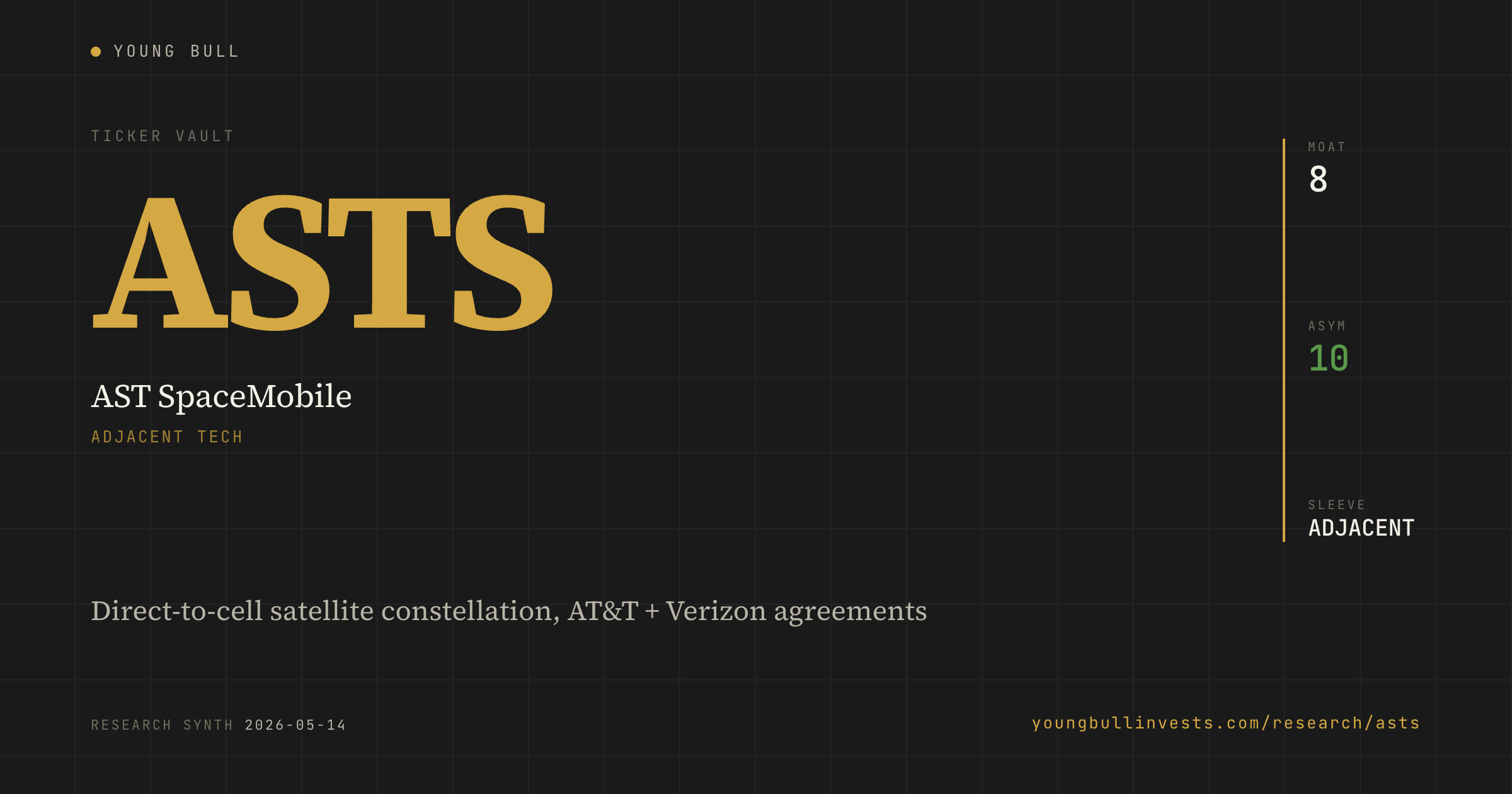
ASTS is the loudest test of the Adjacent Tech sleeve, the 4th sleeve added in manifesto v2 (2026-05-05). Adjacent Tech is not Physical Layer of AI. It is a small set of long-horizon technology bets where the technical risk is concrete and the asymmetric pay is generational. AST SpaceMobile is building the first low-earth-orbit constellation that talks directly to unmodified smartphones. AT&T and Verizon have signed framework agreements. Vodafone is in the European trial. If it works at full scale, the addressable market is every cell phone on Earth. If it slips, the position halves on the way down and the brand has to defend "conviction through drawdown" honestly.
Quinn's book opened ASTS on 2026-04-15. The 2026-05-05 snapshot showed -13.73% (the position was being defended through the launch-cadence skepticism). The 2026-05-11 close moved to +11.50%. After-hours of 5/11 dropped ~8% from $82.55 on the Q1 2026 earnings print, which was a hard double miss.
Recent catalysts (last 30 to 60 days)
- Q1 2026 earnings (May 11) double miss. EPS -0.66 vs consensus -0.20. Revenue $14.73M vs consensus $36.6M, a 59.72% revenue miss. Stock dropped ~8% after-hours. Decision tree at the time was hold the position through the print and decide on Part 2 reaction after the conference call. The miss is on revenue timing, not on launch cadence.
- BlueBird launch cadence intact. Five operational BlueBird-1 satellites in service. Next-gen BlueBird-2 launch window is Q3 2026. The launch schedule is the load-bearing variable for revenue conversion; if it slips, the revenue ramp slips with it.
- AT&T framework formalized. Agreement language tightened on bandwidth allocation and revenue share in the Q4 2025 print. AT&T is the lead carrier customer in the US market.
- FCC orbital debris ruling. Cleared the path for the BB-2 generation. Regulatory overhang reduced.
The thesis (what has to be true)
1. Direct-to-cell satellite stays the cheapest cost-per-bit for cell extension in geographies where terrestrial buildout is uneconomic (rural, mountainous, ocean, supply chain logistics). 2. AT&T and Verizon stay on the customer roster. Either turning into a Starlink-direct-to-cell partner instead would compress the addressable revenue meaningfully. 3. BlueBird-2 launches on schedule (Q3 2026) and the constellation gets to ~50 satellites within 18 months of that date. The math of beam coverage requires constellation scale. 4. The revenue mix shifts from "framework deals" (no revenue today) to "active subscriber revenue per device" within 24 months. The Q1 2026 miss was a timing miss; the 24-month conversion is the thesis.
Kill vectors (what would break the thesis)
- Launch cadence break. A failed BB-2 launch or a 6+ month slip pushes the revenue conversion beyond the financing runway. Cash burn at current rates needs the constellation operational by 2028.
- AT&T or Verizon defection. If either carrier pivots to Starlink for direct-to-cell, ASTS loses the credibility anchor. Predator agent fires on a competitive partnership announcement.
- Spectrum reallocation. ASTS's S-band agreements depend on regulatory continuity. An FCC change of stance (or international counterparts) blows up the cell-extension model.
- Capital event. ASTS has raised at progressively wider spreads. A surprise mark-down secondary breaks the discipline.
Layer context
In the 8-layer Physical Layer of AI map, ASTS sits outside the layers, in the Adjacent Tech sleeve. The sleeve cap is 15% of book. ASTS is currently the largest weight in Adjacent Tech at ~6% of book.
Sister names in Adjacent Tech: RKLB (launch + space components), OUST (lidar / sensing). ASTS is the highest-asymmetry bet of the three, with the largest cap risk on the launch cadence variable. RKLB has the more diversified revenue base. OUST has the lower variance.
Position discipline (the rules at entry)
- Adjacent Tech sleeve rules apply, not Anchor rules.
- No fixed +200% trim level; trim decisions are catalyst-driven (launch success, contract signing, customer milestone).
- Sleeve cap: 15% of book. Currently at ~6%.
- 4-quarter thesis-fail rule applies. If the BB-2 launch is canceled or AT&T defects, full exit on the 4-quarter clock.
- "Conviction through drawdown" framing is the brand stance, NOT permission to ignore kill vectors. If the launch cadence breaks, the position exits regardless of how much was lost on the way down.
Moat 8. Asym 10. The asym is the highest in the book because the addressable market is generational if the technology works and the customer set holds. The moat is high because constellation buildout + spectrum + carrier framework is functionally unreplicable in under 3 years.
Real money. Real position. Real receipts.