ARM research
Position in the Physical Layer of AI thesis
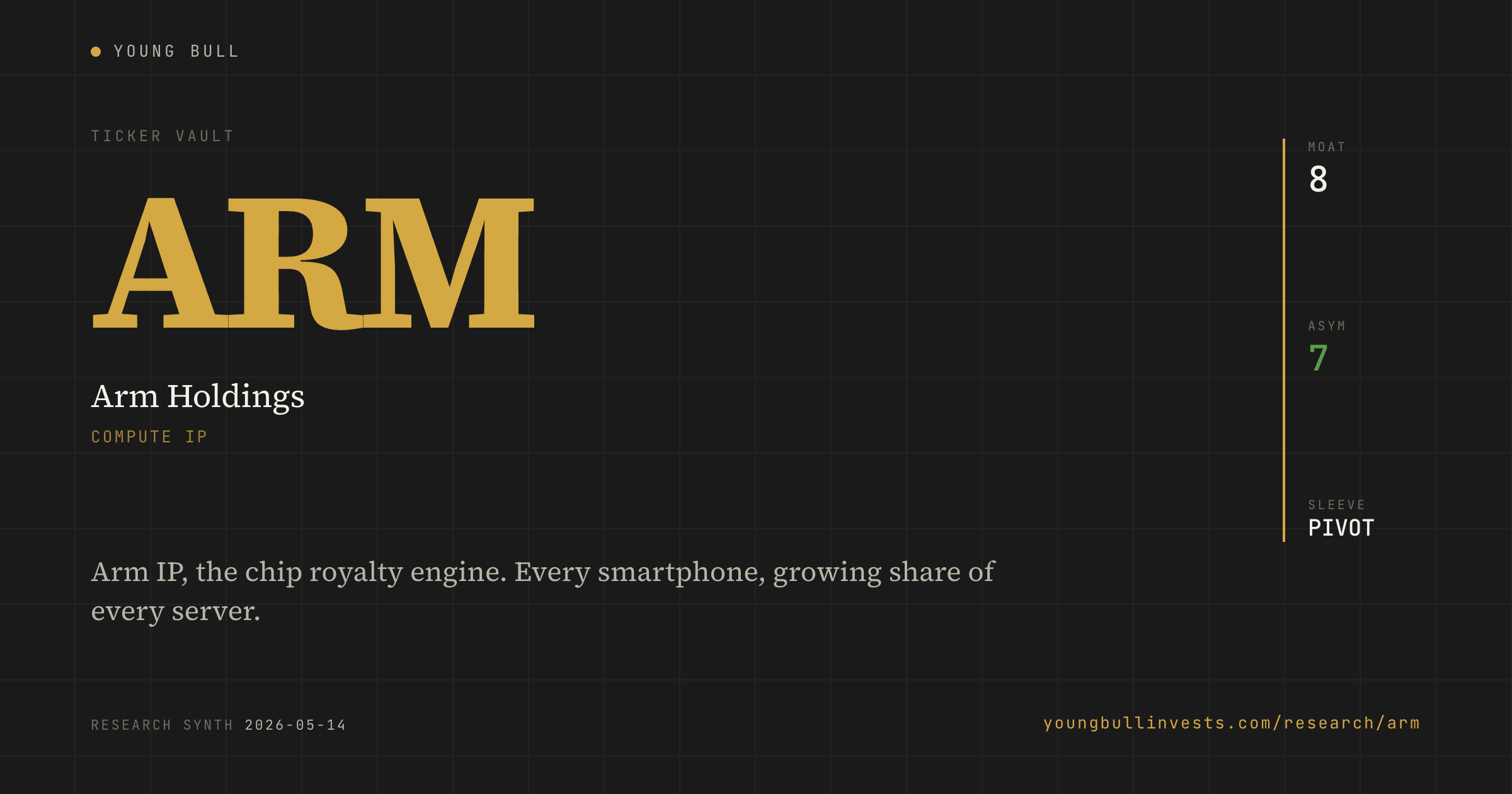
ARM is a Pivot in the Compute IP layer. The Physical Layer of AI map has Compute & Memory as the foundational layer, where MU and AVGO and ON live. ARM sits one level up: the instruction set architecture that nearly every smartphone and a growing share of every datacenter CPU is built on. Every smartphone shipped pays ARM a royalty. Every Nvidia Grace CPU pays ARM a royalty. Every AWS Graviton CPU pays ARM a royalty. The royalty is small per chip; the volume is functionally everything that runs on the planet.
Quinn's book opened ARM on 2026-04-28. The 2026-05-05 snapshot had ARM at +4.27% on a $42 lifetime gain. The position is Sized at 2% of book; ARM is the Pivot, not an Anchor, because the moat (instruction set lock-in) is real but the asym is bounded by share-shift cycles, not new-physics outcomes.
Recent catalysts (last 30 to 60 days)
- Q3 FY26 royalty record. Per-chip royalty revenue printed at an all-time high. Mix shift from mobile to datacenter pushed the average royalty up because server SKUs pay multi-dollar royalties vs mobile cents.
- AGI CPU IP. New core licenses for the AI-PC and AI-server segment. Microsoft Cobalt CPUs, Google Axion CPUs, and the next AWS Graviton generation all on ARM v9.
- Apple license renegotiation. The largest royalty payer in the company. Renewal lands in 2027; the negotiation overhang has compressed the multiple but the renewal is widely expected at higher per-unit terms.
- AI inference at the edge. Smartphone NPUs are the largest deployed-AI-compute surface in the world. Every Android NPU runs on ARM; the entire iPhone Neural Engine is ARM. The "AI moves to the edge" narrative is structurally ARM-positive.
The thesis (what has to be true)
1. Smartphone unit volumes stay above 1.1 billion per year through 2030. Mobile is the baseline royalty stream; if it cracks, the whole business does. 2. Server CPU share keeps rotating to ARM-based architectures (Graviton, Cobalt, Axion, Grace) at 30+ percent CAGR. ARM is the architecture, not the chip; share-shift = royalty-share-shift. 3. Apple does not abandon the architecture. Apple's M-series is the marquee proof; if Apple ever defected to RISC-V, the share equity narrative cracks. 4. The AI-PC + AI-edge categories take off and run on ARM. This is the asymmetric upside; even single-digit share of "AI PCs" is a big absolute royalty number on top of a baseline that doesn't crack.
Kill vectors (what would break the thesis)
- RISC-V share-shift. RISC-V is the open-architecture alternative. Slow today, but the China hyperscalers (Alibaba, Tencent) are explicit RISC-V investors. A faster-than-expected datacenter RISC-V wave compresses the ARM royalty base.
- Apple defection. Lowest probability, highest impact. Apple has built a custom ISA before (PowerPC); the engineering is not impossible.
- Royalty pricing pressure. Big customers occasionally renegotiate down. The Apple renewal in 2027 is the next pressure point.
- AI-on-the-edge stalls. If "AI PCs" remain a marketing gimmick instead of a real category, the asymmetric upside doesn't show up.
Layer context
In the 8-layer Physical Layer of AI map, ARM is the Compute IP slice. AVGO is the dual-layer Compute IP + Networking anchor; ARM is the pure-play Compute IP pivot. Sister names: AVGO (anchor, custom AI silicon), ON (pivot, analog + power chips for Compute & Memory), MU (anchor, memory).
ARM is the lowest-volatility Compute exposure in the book because the royalty model is recurring and the customer set is locked-in by the cost of architectural migration. The trade-off is bounded asym: ARM grows with the unit volumes, not with a new-physics outcome.
Position discipline (the rules at entry)
- Pivot sleeve rules: tighter than Anchor (the +200% trim level becomes +100%), more flexibility to rotate.
- Trim trigger: +100 percent from cost.
- Sleeve cap: pivot sleeve cap is 45% of book. ARM is ~2%.
- 4-quarter thesis-fail rule applies. If smartphone units crack or Apple renegotiates down, the clock starts.
Moat 8. Asym 7. The moat is among the highest in the book because the instruction set lock-in compounds across two decades of customer code. The asym is moderate because the upside is share-shift mathematics, not a constellation-scale outcome.
Real money. Real position. Real receipts.