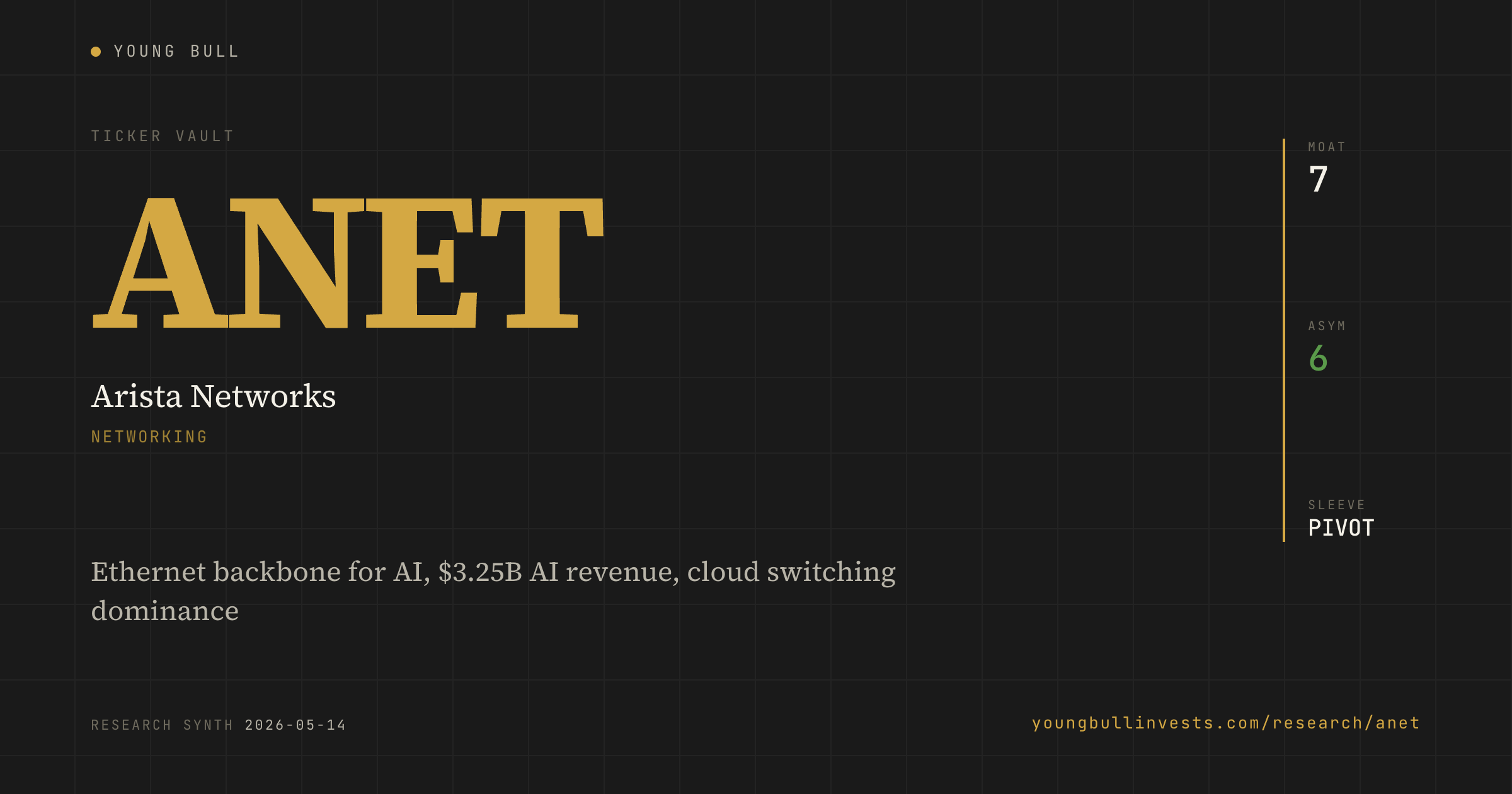
ANET research
Position in the Physical Layer of AI thesis
ANET is the Networking pivot. The Physical Layer thesis says AI workloads cannot move data between GPUs fast enough without specialized fabric. Arista builds the Ethernet switches that every cloud hyperscaler buys when they don't want Nvidia's InfiniBand lock-in. Microsoft, Meta, Oracle Cloud, and Apple all run on Arista in their AI training pods. AVGO is the anchor in this layer because Broadcom OWNS the merchant silicon that goes inside many Arista boxes. ANET is the system-vendor pivot one level up.
Quinn's book opened ANET on 2026-02-11. The 2026-05-05 snapshot had ANET at +19.40%. The position is 1.6% of book, sized as a small pivot rather than an anchor because the customer concentration on Microsoft + Meta has both sides of the tail.
Recent catalysts (last 30 to 60 days)
- $3.25B AI revenue target (Q1 print). Management raised the 2026 AI-specific revenue target on the back of strong cloud-hyperscaler bookings. Arista has been consistent on guidance for ~6 quarters running, which is the credibility marker.
- 800G mix expansion. 800G port shipments crossed 25 percent of cloud-segment revenue. The transition from 400G to 800G is the load-bearing refresh cycle for the next 24 months.
- Etherlink + Ultra Ethernet Consortium leadership. Arista is the named technical chair of the UEC, the standards group that is trying to make Ethernet match InfiniBand for AI training. The narrative leadership matters because hyperscalers want a standard, not a Nvidia-only fabric.
- Apple won as a public customer. WWDC 2025 disclosed Apple Cloud running on Arista. Apple's secrecy on infrastructure makes any disclosure a big signal.
The thesis (what has to be true)
1. Ethernet keeps eating InfiniBand share for AI training fabric. UEC + 800G migration is the structural lever. 2. Hyperscaler capex stays high through 2027. ANET grows with the spending; if capex breaks, ANET breaks with it. 3. AVGO doesn't disintermediate Arista. AVGO sells the silicon to multiple system vendors; ANET stays preferred at the lead hyperscalers because of operational integration. 4. The AI inference build-out (vs training) keeps using Ethernet too. Inference clusters are smaller and more numerous, which favors Ethernet's incumbent operational tooling.
Kill vectors (what would break the thesis)
- Nvidia Spectrum-X wins the fabric. Nvidia is pushing Spectrum-X aggressively, bundled with GPU sales. If hyperscalers consolidate Nvidia silicon + Nvidia fabric, ANET loses the lead-customer position.
- Microsoft or Meta in-house switch. Both have rumored homegrown switch programs. If either deploys in-house silicon for 30+ percent of capacity, ANET's growth math compresses.
- AVGO direct-sells. Broadcom could pivot to selling reference designs that bypass system vendors. Less likely (margin-destructive for AVGO) but worth tracking.
- Capex cyclical break. Arista is highly cloud-concentrated. A hyperscaler capex pause is a 20-30 percent earnings event.
Layer context
In the 8-layer Physical Layer of AI map, ANET is in Networking. AVGO is the dual-layer anchor (Compute IP + Networking); NOK is the telco-side pivot. Arista is the cleanest AI-fabric pure-play among the three, with no telco overhang and no custom-silicon side business.
Position discipline
- Pivot sleeve rules.
- Trim trigger: +100 percent from cost.
- Sleeve cap: 45%; layer cap: 30%. Networking layer is well under cap.
- 4-quarter thesis-fail rule applies.
Moat 7. Asym 6. The moat is high because operational integration at hyperscalers locks the customer for 3+ years. The asym is moderate because the upside is share-shift in an already-large market, not a new-category outcome.
Real money. Real position. Real receipts.