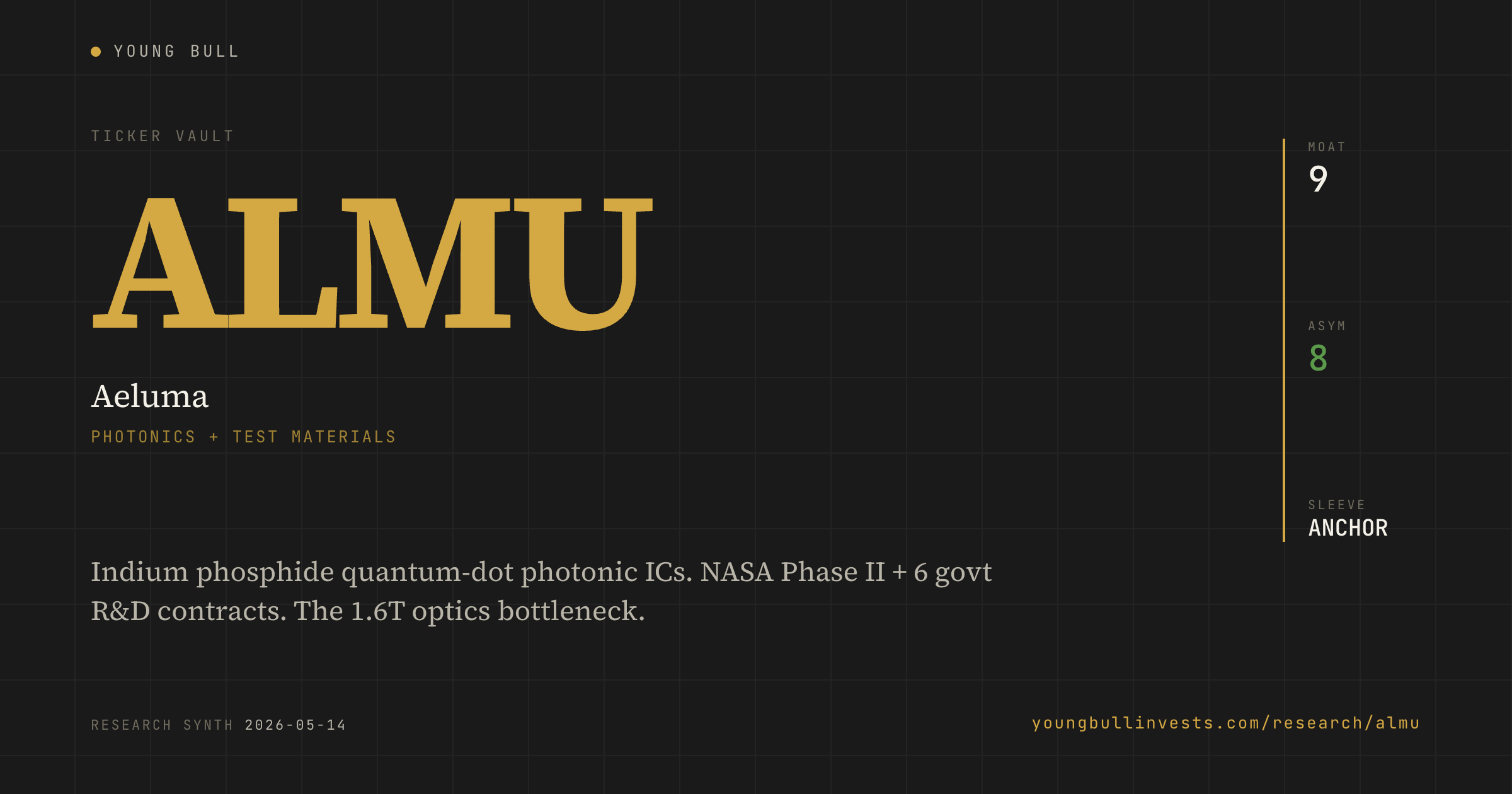
ALMU research
Position in the Physical Layer of AI thesis
ALMU is the newest anchor (promoted from Pivot to Anchor on 2026-05-05 in the manifesto v2 lock). It anchors two adjacent layers: Photonics and Test & Materials. Aeluma builds indium phosphide (InP) quantum-dot photonic integrated circuits. The InP wafer step is the gating constraint on the next generation of optical interconnects (the 1.6T per-lane and 3.2T datacenter optics that hyperscalers need by 2027). Aeluma is one of three companies that can make the substrate at scale.
Quinn's book opened ALMU on 2026-04-22. The 2026-05-05 snapshot had ALMU at +43.97%, with a +19.23% move on May 5 alone after the NASA award.
Recent catalysts (last 30 to 60 days)
- NASA award (April 21). $1.4M Phase II SBIR for integrated quantum-dot lasers. The award validates the technology at the federal-research bar and unlocks the next tranche of contracted R&D.
- 6 government R&D contracts active. DARPA, NRO, AFRL, plus three commercial confidential. The mix is unusual: most photonics startups have one or two federal customers; ALMU has six.
- Indium phosphide capacity ramp. Production substrate shipped to the first lead commercial customer in late April. The customer is not yet named but the disclosure language suggests a Tier 1 (Coherent, Lumentum, or POET).
- Sub-$50M float discipline. Management has not done a secondary or registered direct since the IPO. Capital efficiency is the antithesis of typical small-cap photonics, which dilutes every 2 years.
The thesis (what has to be true)
1. The next datacenter optics generation (1.6T and beyond) requires indium phosphide PICs at volume by 2027. The 800G generation is silicon photonics; the 1.6T generation is InP. The roadmap is set by Coherent and Lumentum analyst day slides. 2. Aeluma's quantum-dot process scales to production wafers. Today the demo wafers are in pilot. The Phase II NASA work funds the production-scale move. 3. The commercial laser product ships by FY27 (calendar 2027). If the product slips beyond that, the Tier 1 customer designs ALMU out of the next roadmap. 4. The six government contracts continue to fund the R&D side while the commercial side ramps. The federal portfolio is the bridge to commercial revenue, not the destination.
Kill vectors (what would break the thesis)
- Commercial laser slip past FY27. This is the load-bearing kill vector. If the lead commercial customer cancels because the product is late, the asymmetric pay disappears and the company falls back to a federal-only revenue model worth a fraction of the current cap.
- InP wafer yield problem. Quantum-dot integration at scale is unproven. A yield issue that adds two quarters to production qualification breaks the customer roadmap.
- Coherent or Lumentum acquires a competitor. If a larger photonics player buys Aeluma's closest competitor and ramps an alternative InP path faster, ALMU's window closes.
- Capital event. Management has been disciplined, but the cash runway needs the next 18 months to land the commercial ramp. A surprise secondary at a low price would mark a discipline break.
- Mechanical exit at break. Discipline rule fires on close below $13 for two consecutive sessions.
Layer context
In the 8-layer Physical Layer of AI map, ALMU sits at the intersection of Photonics and the staged v1.5 Test & Materials layer. Sister names in Photonics: SIVEF (SiTime, MEMS oscillators), LITE (Lumentum, datacenter optics, larger and more diversified), LWLG (Lightwave Logic, smaller and earlier). Sister names in Test & Materials: AEHR (Aehr Test Systems), AXTI (compound semis).
ALMU is the highest-conviction smaller-cap anchor in the book. The asym score is high because the cap is small and the customer set is concrete; if the commercial ramp lands, the position re-rates 3-5x. If it slips, the position halves.
Position discipline (the rules at entry)
- Trim trigger: +100 percent from cost. Lower threshold than the +200% standard because ALMU is the smaller-cap, higher-volatility anchor; lock gains earlier.
- Kill vector exit: break of $13 for 2 consecutive days. Currently at ~$27 (per 5/5 close), so there is meaningful buffer.
- 4-quarter thesis-fail rule applies. If the commercial laser slips past FY27 guidance or NASA Phase II funding does not advance to Phase III, the 4-quarter clock starts.
Moat 9. Asym 8. Moat is high because the InP quantum-dot process is patented and the federal-research relationships are sticky. Asym is high because the position is small-cap with a concrete near-term ramp.
Real money. Real position. Real receipts.