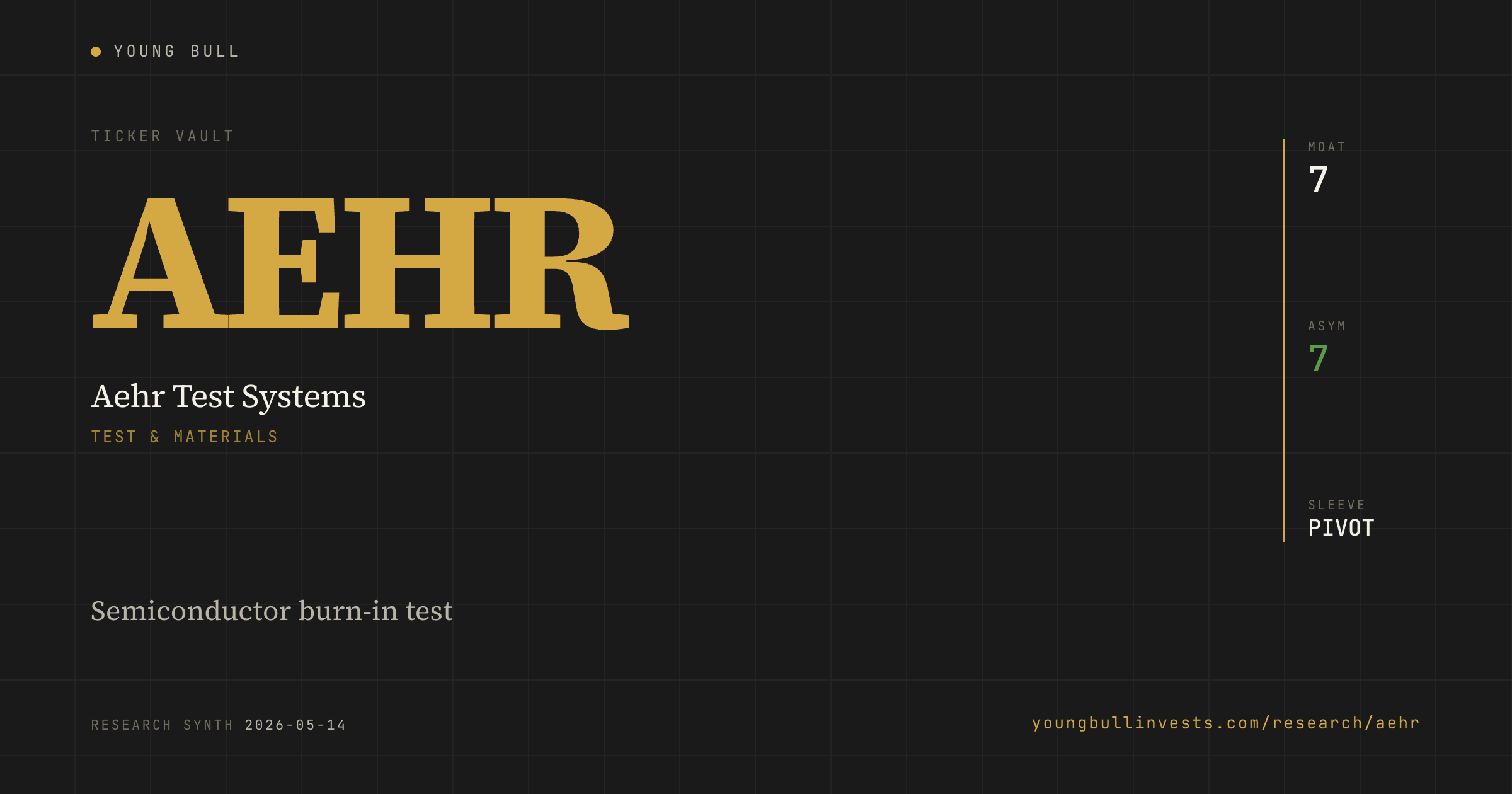
AEHR research
Position in the Physical Layer of AI thesis
AEHR is a Test & Materials pivot. The Physical Layer of AI map's staged 9th layer (Test & Materials) is the bottleneck nobody talks about: every new chip generation needs longer burn-in test cycles to qualify for hyperscaler reliability requirements, and AEHR is the merchant supplier of wafer-level burn-in systems. The story: as AI silicon proliferates (HBM, custom ASICs, optical I/O), the test-cycle volume grows faster than the silicon volume. AEHR captures that growth differential.
Quinn's book opened AEHR on 2026-04-28. The 2026-05-05 snapshot had AEHR at +11.37%. Sized at 2.6% of book.
Recent catalysts (last 30 to 60 days)
- $41M lead-hyperscaler order. Management disclosed in the Q4 FY26 print a single-customer order from a "leading hyperscaler" for AEHR's photonics-test platform. Triangulates to either a custom-AI-silicon program or an optical-I/O qualification line.
- HBM3 test platform shipping. New product specifically for the memory-burn-in segment. AEHR was historically silicon-carbide-test concentrated; the HBM expansion diversifies the customer mix.
- Geographic diversification. Korea + Taiwan customer mix grew from <20 percent to ~35 percent of revenue over four quarters. The dependency on US/Europe customers reduced.
- R&D spend up 30 percent YoY. Management is investing in next-gen platforms (FOX-XP3, next-gen WaferPak). Forward optionality.
The thesis (what has to be true)
1. AI silicon proliferation continues. More chip types = more test-line variation = more AEHR platforms sold. 2. The hyperscaler burn-in requirements stay strict. If quality bar drops (which it never does), test volumes drop. 3. AEHR captures the photonics-test segment. The Q4 order is the proof point; the next quarters either expand or the trade pauses. 4. AEHR doesn't get acquired at the wrong price. The company is small enough that any of Teradyne, Advantest, or Cohu could buy it.
Kill vectors (what would break the thesis)
- Customer concentration shock. AEHR has historically been single-customer-heavy. If the lead silicon-carbide customer (rumored to be Onsemi) pauses orders, revenue compresses fast.
- Test-cycle compression. If AI customers accept shorter burn-in cycles to ship faster, AEHR's revenue-per-chip drops.
- Competitor reference design. Teradyne or Advantest could ship a comparable system at a lower price.
- Acquisition at low price. Friendly takeout below current cap would lock in the loss for outside holders.
Layer context
Test & Materials is the staged v1.5 layer in the map. Sister names: AXTI (compound semis, both Test & Materials and Photonics), TRT (semi backend test services, smaller and lower-margin). AEHR is the highest-quality merchant burn-in pure-play in public markets.
Position discipline
- Pivot sleeve rules.
- Trim trigger: +100 percent from cost.
- 4-quarter thesis-fail rule applies. If the lead-hyperscaler order doesn't convert to repeat or the silicon-carbide customer pauses, the clock starts.
Moat 7. Asym 7. The moat is high because burn-in expertise compounds across customer engagements. The asym is moderate because the addressable market is bounded by global semi production, which is a real ceiling.
Real money. Real position. Real receipts.